Geospatial Data Management for Electric Grid Infrastructure - SIG 

The management of electrical networks (HV/MV/LV), public lighting, substations, cabinets and service connections relies on the quality of a key asset: geospatial information.

When this information is incomplete, outdated or inconsistent, the entire operational chain becomes fragile: longer field interventions, increased compliance risks, difficulties in asset management and loss of information when changing tools or service providers.

This page presents the operational challenges faced by power network operators, as well as the structuring role of electric network data standards used to model and manage infrastructure data. Our objective is to provide GIS solutions, SaaS platforms or custom developments tailored to your operational needs, making data usable, interoperable and easier to leverage for decision-making.

Why Geospatial Data Is Essential for Electric Grid Management

Electrical infrastructures, which are critical networks, have specific characteristics that make data management particularly demanding.

GIS data is not just a “map”: it is the shared foundation that enables the operation, maintenance, security and investment planning of electric networks.

Data therefore becomes the shared foundation for:

  • Extensive infrastructure assets distributed across the territory

  • Underground and overhead assets, sometimes difficult to access

  • Multi-stakeholder management (surveyors, engineering firms, contractors, public authorities)

  • Safety, compliance and traceability requirements

Key Operational Challenges
(and Their Impacts)

Do you need to manage, improve the reliability of or structure the geospatial data of your electric grid? 

FAQ - GIS and Web GIS for Electric Networks

Why use a GIS to manage an electric network?

Using a GIS to manage an electric network helps structure and visualise complex infrastructure composed of high-, medium- and low-voltage lines, substations, cabinets, connection points and associated equipment. Electric networks are extensive, constantly evolving and often shared between multiple stakeholders. GIS therefore becomes the common foundation that allows operators to precisely locate assets, link technical information to spatial data and secure field interventions. A GIS is not only about mapping a network. It provides a reliable geospatial database used to operate, maintain and develop infrastructure assets over time.

What is the role of a Web GIS for utilities or public authorities managing electric networks?

A Web GIS makes geospatial data accessible to all stakeholders through a browser, without requiring specialised desktop GIS software. In the electricity sector, this enables field teams, operations managers, technical departments and decision-makers to easily access network information. A Web GIS helps visualise assets, analyse intervention zones, monitor operations and share up-to-date information. ConnectServices addresses this challenge by providing a Web GIS platform designed for operational use and the management of territorial data related to electric networks.

How does geospatial data quality impact electric network operations?

The quality of geospatial data directly affects the safety and efficiency of operations on electric networks. Imprecise or outdated data can lead to location errors, longer interventions and increased operational risks. Reliable data, on the other hand, helps teams quickly identify relevant assets, prepare works, coordinate interventions and reduce uncertainty. Over the long term, geospatial data quality also influences infrastructure planning, asset management and regulatory compliance. GIS data therefore becomes a key driver of operational performance.

How can GIS data for electric networks be kept up to date after works?

Construction works, network extensions and maintenance operations are the main reasons for discrepancies between the real network and its representation in GIS. To avoid this gap, network changes must be captured when they occur, validated and then integrated into the database. ConnectField enables structured field data collection and updates directly on site. ConnectControl verifies data quality and consistency before integration. ConnectServices then converts CAD (DWG) data into GIS formats and distributes the consolidated dataset through a Web GIS accessible to all stakeholders. This end-to-end workflow ensures long-term data reliability.

Why use data models and standards for electric network data?

Data models and industry standards help structure the representation of electric network assets and ensure consistency across datasets. They define common objects, attributes and relationships that make data easier to understand, exchange and maintain over time. Using structured geospatial data models reduces interpretation errors and helps maintain consistent infrastructure knowledge even when organisations, tools or service providers change.

Are industry data standards mandatory for electric network data?

In many contexts, these standards are not strict regulatory requirements. However, they are increasingly used as references in infrastructure projects, data structuring initiatives and public procurement processes. Their adoption helps secure data production, facilitate collaboration between stakeholders and reduce risks when tools or service providers change.

Do data standards alone guarantee data quality?

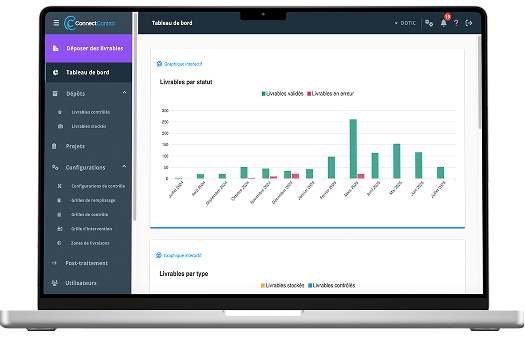
No. Data standards define how information should be structured, but they do not automatically guarantee data quality. Topology errors, missing attributes, inconsistencies or missing updates after works may still occur even if the data formally respects a model. This is why quality control processes are essential. ConnectControl allows automated validation of business rules, detection of inconsistencies and objective qualification of datasets before they are used operationally. Combining structured data models with robust quality control ensures long-term reliability.

Why control the quality of GIS data for electric networks?

Quality control ensures that geospatial data remains reliable for both operational and strategic decision-making. Without verification, datasets can quickly lose consistency, especially when multiple actors contribute to their production. Quality control helps detect anomalies before integration, secure deliverables from contractors and maintain transparency in contractual exchanges. It also improves traceability and long-term data governance.

Why choose a specialised solution rather than an open-source solution for electric network data management?

Open-source solutions can be powerful and relevant, but they often require strong internal expertise, advanced configuration and continuous maintenance to integrate sector-specific rules. A specialised solution generally enables faster deployment of structured data models, built-in quality checks and operational functionalities adapted to electric network management. Dotic’s approach focuses on interoperability. The objective is not to lock data into a proprietary system but to ensure reliability, sustainability and compatibility with existing information systems.

Are Dotic solutions suitable for high-, medium- and low-voltage networks?

Yes. Dotic solutions are designed to support the full lifecycle of electric network data, including high-, medium- and low-voltage infrastructure as well as public lighting networks. ConnectField enables field data collection and updates. ConnectControl ensures data quality control and validation. ConnectServices enables visualisation, operational use and data governance through a Web GIS platform. This integrated approach turns geospatial data into a true operational and asset management tool.

Who are Dotic solutions designed for in the electricity sector?

Dotic solutions are designed for municipalities, energy syndicates, utilities, grid operators, engineering firms, surveyors and service providers involved in the construction or operation of electric infrastructure. They support organisations seeking to structure, control, operate and maintain their geospatial data with a collaborative approach focused on reliability and ease of use.

À qui s’adressent les solutions Dotic dans le secteur électrique ?

Les solutions Dotic s’adressent aux collectivités, syndicats d’énergie, exploitants, gestionnaires de réseaux, bureaux d’études, géomètres et prestataires impliqués dans la construction et/ou l’exploitation d’une infrastructure électrique. Elles répondent aux besoins de structuration, de contrôle, d’exploitation et de pérennisation des données, avec une approche collaborative et orientée fiabilité, simplicité d’usage.